
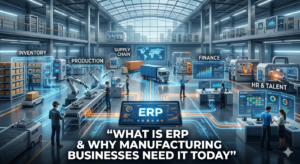
ERP connects every manufacturing function into a unified digital system.
Manufacturing businesses today operate in an environment where speed, accuracy, and data-driven decision-making define success. From raw material procurement to production planning and final delivery, every stage requires seamless coordination. This is where Enterprise Resource Planning (ERP) becomes essential.
An ERP system for manufacturing industry integrates all core business functions into a single centralized platform. Instead of using separate tools for finance, inventory, HR, production, and sales, ERP unifies everything in real time. This improves efficiency, reduces operational delays, and ensures better visibility across departments.
Modern manufacturers face challenges such as supply chain disruptions, rising competition, and increasing customer expectations. Traditional systems cannot handle this complexity effectively. ERP solves this by providing a connected ecosystem where data flows automatically between departments.
Key focus areas in this guide include:
By the end, you will clearly understand how ERP transforms manufacturing businesses into scalable, efficient, and future-ready organizations. Whether you’re a small factory owner or a large-scale industrial operator, ERP is no longer optional—it is a necessity for survival and growth in the digital era.
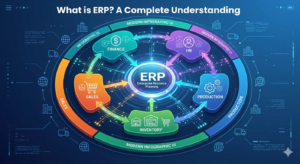
ERP integrates all business functions into one platform.
ERP (Enterprise Resource Planning) is a software system designed to manage and integrate all major business processes within an organization. It acts as a central database where every department shares and accesses real-time information.
At its core, ERP eliminates data silos. For example, when a sales order is placed, the system automatically updates inventory, alerts production, adjusts financial records, and schedules delivery—all without manual input.
A modern ERP system includes multiple modules such as:
Leading ERP solutions like SAP, Oracle, and Microsoft Dynamics 365 are widely used across industries, especially manufacturing.
The main goal of ERP is simple: improve efficiency and decision-making by providing accurate, real-time data.
Instead of relying on multiple disconnected systems, businesses use ERP to create a unified operational structure. This reduces errors, saves time, and enhances productivity.
In short, ERP is the digital backbone of modern enterprises, enabling businesses to operate smarter, faster, and with greater precision in an increasingly competitive environment.
To understand ERP fully, it is important to start with ERP basics. ERP is built on the principle of integration—bringing all business functions under one digital system.
At a basic level, ERP works in three layers:
The system ensures that every department works on the same updated data, eliminating duplication and inconsistencies.
Key ERP basics include:
For manufacturing businesses, ERP basics are especially important because production environments require accurate coordination between inventory, machines, labor, and supply chain.
Without ERP, companies often face:
ERP resolves these issues by creating a unified operational system.
Understanding these basics helps businesses realize that ERP is not just software—it is a complete management framework designed to streamline operations and improve decision-making efficiency across the organization.
The ERP system for manufacturing industry is specifically designed to handle complex production workflows, supply chain management, and resource optimization. Manufacturing businesses deal with multiple variables such as raw materials, machine scheduling, labor allocation, and delivery timelines.
ERP brings all these elements together in one integrated platform.
Key features of manufacturing ERP include:
Manufacturers rely on precision. Even a small delay in raw material supply can disrupt the entire production cycle. ERP ensures that all processes are synchronized in real time.
For example, when inventory levels drop, the system automatically triggers procurement requests. Similarly, production managers can track machine efficiency and downtime instantly.
Benefits of ERP in manufacturing:
By adopting ERP, manufacturers gain complete visibility into their operations. This leads to improved productivity, reduced waste, and higher profitability.
In today’s competitive industrial environment, ERP is no longer optional—it is a critical tool for maintaining efficiency and staying ahead of market demands.
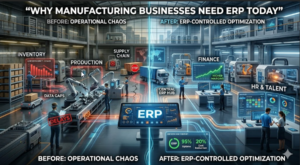
ERP transforms manufacturing chaos into efficiency.
Manufacturing businesses today face increasing pressure from global competition, rising operational costs, and customer demand for faster delivery. Traditional management systems are no longer sufficient to handle this complexity.
ERP provides a centralized solution that enhances control and visibility across the entire production lifecycle.
Key reasons manufacturers need ERP today:
Without ERP, businesses often rely on manual spreadsheets and disconnected systems, which lead to inefficiencies and errors.
Modern ERP platforms help manufacturers:
With solutions from providers like Microsoft Dynamics 365, manufacturers can also integrate AI and analytics for smarter decision-making.
The need for ERP has become urgent because manufacturing is no longer just about production—it is about data-driven operations.
Companies that adopt ERP gain a competitive advantage, while those that delay risk falling behind in efficiency, profitability, and market relevance.
ERP is now a strategic investment, not just an operational tool.
An ERP system consists of several interconnected modules that support different business functions. In manufacturing, these modules work together to streamline operations and improve efficiency.
Key ERP modules include:
Each module shares data in real time, ensuring consistency across the organization.
For example, when production increases, the inventory module automatically updates material requirements, while the finance module reflects cost changes.
This integration reduces manual effort and improves decision-making accuracy.
Manufacturing ERP systems are designed to handle complex workflows, ensuring that every stage of production is monitored and optimized.
By using a modular approach, businesses can also scale ERP systems as they grow, adding new features without disrupting existing operations.
This flexibility makes ERP suitable for both small manufacturers and large industrial enterprises.
ERP delivers significant advantages to manufacturing businesses by improving efficiency, accuracy, and operational control.
Key benefits include:
ERP also improves customer satisfaction by ensuring faster order fulfillment and accurate delivery timelines.
Point-based advantages:
With platforms like Oracle and SAP, manufacturers can leverage advanced analytics, AI, and automation features.
Overall, ERP transforms manufacturing businesses into highly efficient, data-driven organizations capable of adapting quickly to market changes and customer demands.
Implementing ERP in a manufacturing business is a structured process that requires planning, analysis, and execution.
Steps involved:
Important considerations:
Manufacturers often prefer systems like Microsoft Dynamics 365 due to flexibility and cloud capabilities.
A successful ERP implementation improves efficiency, reduces downtime, and ensures smooth transition from legacy systems.
Proper planning is essential because ERP impacts every department in the organization.
While ERP offers numerous benefits, its implementation comes with challenges that businesses must address carefully.
Common challenges include:
Many manufacturing companies struggle during the transition phase because employees are used to traditional systems.
Point-based challenges:
To overcome these challenges, businesses should:
Despite these challenges, the long-term benefits of ERP outweigh the initial difficulties.
Modern ERP systems from providers like SAP and Oracle are designed to minimize complexity through cloud-based deployment and automation features.
With proper planning and execution, ERP adoption becomes a smooth and highly rewarding transformation for manufacturing businesses.
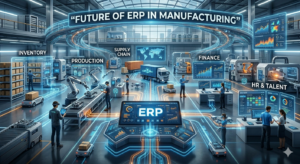
ERP is evolving into intelligent automation systems.
The future of ERP is evolving rapidly with advancements in artificial intelligence, machine learning, and cloud computing.
Modern ERP systems are becoming smarter and more predictive, helping manufacturers make data-driven decisions in real time.
Future trends include:
Manufacturing businesses will benefit from automated decision-making systems that reduce human intervention and improve accuracy.
Point-based future developments:
Platforms like Microsoft Dynamics 365 are already integrating AI tools to improve manufacturing efficiency.
The future ERP system will act as a fully intelligent business assistant, capable of predicting demand, optimizing production, and reducing operational risks.
Manufacturers who adopt modern ERP technologies early will gain a significant competitive advantage in the global market.
Choosing the right ERP system is crucial for manufacturing success. The decision depends on business size, industry needs, and scalability requirements.
Key factors to consider:
Manufacturers should evaluate ERP vendors carefully before making a decision.
Point-based selection criteria:
Popular ERP solutions like SAP, Oracle, and Microsoft Dynamics 365 are widely trusted in the manufacturing sector.
The right ERP system should align with long-term business goals and support future expansion.
A well-chosen ERP system ensures operational efficiency, better decision-making, and sustainable growth.
Enterprise Resource Planning has become the backbone of modern manufacturing businesses. It connects every department, streamlines operations, and provides real-time insights that drive smarter decision-making.
From understanding ERP basics to exploring the importance of an ERP system for manufacturing industry, it is clear that ERP is no longer just a technological upgrade—it is a strategic necessity.
Manufacturers who adopt ERP benefit from:
In contrast, businesses that delay ERP adoption risk inefficiencies and loss of competitiveness.
With advanced platforms from SAP, Oracle, and Microsoft Dynamics 365, manufacturers now have powerful tools to transform their operations.
In conclusion, ERP is the foundation of digital transformation in manufacturing. It enables businesses to scale, adapt, and thrive in a rapidly evolving global market.
Investing in ERP today means building a stronger, smarter, and more resilient manufacturing future.

A profitable business does not merely depend on a good product but is significantly liable...

The ERP manufacturing companies are evolving and expanding at a rapid pace, thereby increasing competition...

In a short span of time, customer relationship management software has enormously advanced and picked...

Every year, we see the rise of new technologies., With each rising technology, we see...

The emerging economies are powering global growth. The world has witnessed the rise of manufacturing...

India is the world’s largest home to small and large-scale industries and a central hub...
The outbreaks of the Covid-19 virus caused worldwide panics and delivered a consequential blow to...
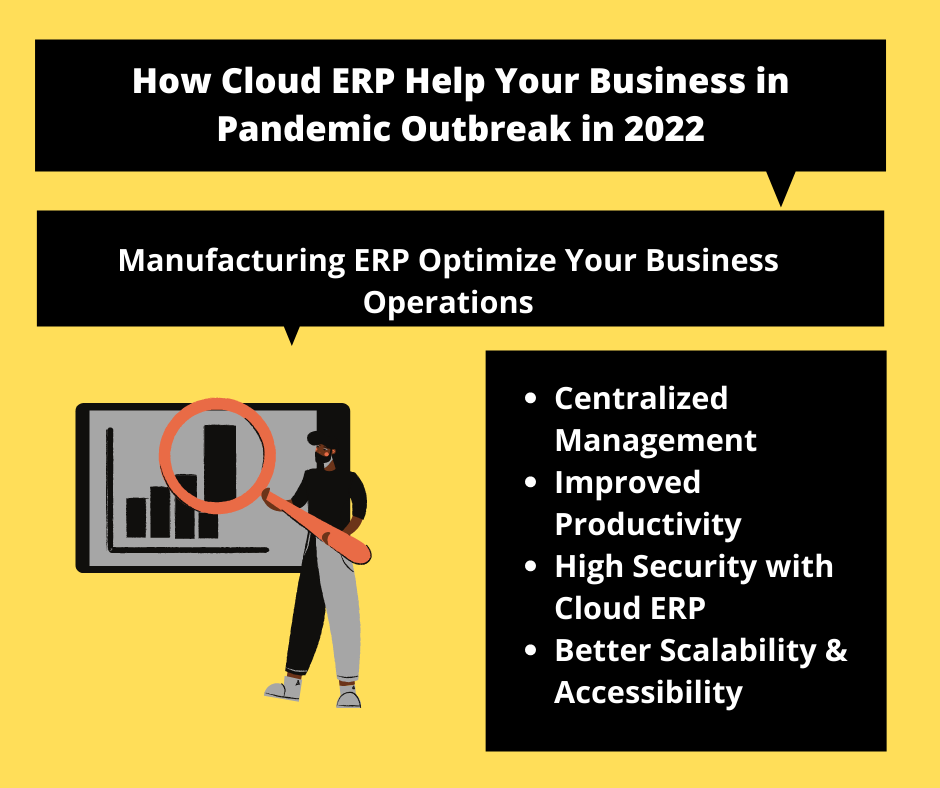
When the Cloud ERP Covid-19 pandemic came upon. It ushered in radical uncertainty and caused...

