Modern Manufacturing ERP software powering smart factories through automation, analytics, inventory management, and production planning.
Manufacturing businesses operate in a fast-paced environment where production planning, inventory management, procurement, quality control, finance, and customer service must work together efficiently. Managing these processes manually or through disconnected systems often leads to delays, errors, and higher operational costs. This is where ERP software for manufacturing becomes a valuable business solution. A well-designed Manufacturing ERP software centralizes business operations, improves visibility across departments, and helps organizations make informed decisions using real-time data.
Selecting the best ERP software for the manufacturing industry depends on several factors, including company size, production type, budget, customization requirements, and future scalability. Modern ERP platforms support automation, supply chain optimization, predictive maintenance, production scheduling, and advanced reporting to help manufacturers stay competitive.
A Manufacturing ERP system is a centralized software platform designed to manage and automate various manufacturing processes. Instead of using multiple standalone applications, manufacturers can integrate production planning, inventory, purchasing, finance, sales, warehousing, and human resources into one system.
The primary objective of an ERP system is to eliminate data silos, improve communication between departments, and provide real-time operational visibility. Whether a company produces automotive components, electronics, textiles, pharmaceuticals, food products, or industrial equipment, ERP software simplifies business management while reducing manual work.
Modern ERP systems also support cloud deployment, mobile accessibility, AI-powered forecasting, and business analytics, making them suitable for businesses of all sizes.
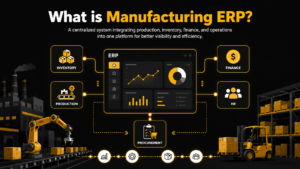
Centralized ERP system connecting all manufacturing operations.
Key Points
Manufacturers often struggle with inventory shortages, production delays, machine downtime, inaccurate forecasting, and rising operational costs. Implementing ERP software for manufacturing companies helps address these challenges by providing complete visibility across business functions. Managers gain access to accurate production data, inventory levels, customer orders, supplier information, and financial reports from a single dashboard.
An ERP solution also improves collaboration between departments. Sales teams can check inventory instantly, procurement teams can automate purchasing, and production managers can schedule manufacturing activities based on real-time demand.
Key Points
The best ERP software offers much more than accounting and inventory management. It provides advanced capabilities that support the complete manufacturing lifecycle. Businesses should evaluate ERP solutions based on production requirements, reporting capabilities, automation features, integration options, scalability, and ease of use.
Core modules usually include production planning, inventory management, warehouse management, procurement, quality control, customer relationship management (CRM), finance, maintenance management, and analytics.
Cloud-based ERP systems also offer secure remote access, automatic software updates, and lower infrastructure costs compared to traditional on-premise solutions.
Several ERP platforms have established themselves as reliable solutions for manufacturing businesses. The right choice depends on production complexity, company size, industry specialization, and budget.
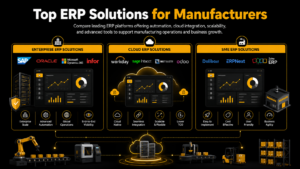
Comparison of leading ERP platforms for manufacturing businesses.
SAP S/4HANA is ideal for large enterprises requiring advanced manufacturing, supply chain, and financial capabilities. Oracle NetSuite ERP offers a cloud-first platform suitable for growing manufacturers. Microsoft Dynamics 365 Business Central combines flexibility with seamless integration across Microsoft products.
Odoo ERP has become a popular choice among small and medium manufacturers because of its modular architecture and cost-effective implementation. Infor CloudSuite Industrial, Epicor Kinetic, and IFS Cloud are also widely used by manufacturing organizations requiring industry-specific functionality.
Businesses seeking customized manufacturing automation can also choose specialized ERP development services tailored to their production workflows.
Key Points
Selecting an ERP system requires careful planning rather than focusing solely on software popularity. Every manufacturer has different operational requirements, production methods, compliance standards, and business goals.
Businesses should first identify their current operational challenges and future expansion plans. Scalability is especially important because manufacturing operations often grow over time. Integration with existing accounting software, CRM, warehouse management systems, and production equipment should also be evaluated.
Another important consideration is vendor support, implementation expertise, employee training, and software maintenance.
Key Points
Implementing ERP software for manufacturing delivers measurable improvements across business operations. Manufacturers gain better visibility into production schedules, inventory movement, supplier performance, customer demand, and financial performance.
Automation reduces repetitive tasks while improving data accuracy. Managers can monitor production efficiency in real time, helping them identify bottlenecks before they impact delivery schedules. ERP systems also improve traceability, making it easier to comply with industry regulations and quality standards.
The result is increased productivity, lower operational costs, faster order fulfillment, improved customer satisfaction, and stronger profitability.
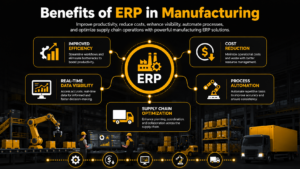
Key advantages of ERP software in manufacturing operations.
Key Points
Although ERP software provides significant long-term benefits, implementation requires careful planning and change management. Many projects face delays due to poor requirement gathering, inadequate employee training, unrealistic timelines, or insufficient executive support.
Successful implementation begins with defining business objectives, selecting the right implementation partner, cleaning existing data, and involving employees throughout the project. Continuous training and post-implementation support help maximize ERP adoption.
Organizations should also monitor performance after deployment and optimize workflows based on operational insights generated by the ERP platform.
Key Points
Digital transformation has become essential for manufacturers seeking long-term competitiveness. ERP software serves as the foundation for integrating technologies such as Industrial IoT, Artificial Intelligence, predictive analytics, machine learning, robotics, and cloud computing.
By collecting data from machines, suppliers, warehouses, and customers, ERP systems create a unified information ecosystem that supports faster and smarter decision-making. Real-time dashboards enable executives to monitor production performance, resource utilization, and financial health from anywhere.
Companies offering digital transformation, custom ERP implementation, software development, and manufacturing automation services can naturally integrate ERP with existing business systems to improve operational efficiency while supporting future business growth.
Key Points
References
Choosing the right ERP software for manufacturing is only the first step. A successful implementation requires careful planning, clear business objectives, employee involvement, and ongoing support. Manufacturers should begin by evaluating their existing processes and identifying areas where automation can improve efficiency. Creating a phased implementation plan helps reduce disruptions while ensuring each department adapts smoothly to the new system.
Working with an experienced ERP implementation partner can also improve project outcomes by minimizing risks and ensuring the software aligns with business goals.
Key Points
The future of Manufacturing ERP software is driven by digital innovation. Cloud computing, Artificial Intelligence (AI), Machine Learning (ML), and Industrial Internet of Things (IIoT) are transforming how manufacturers manage production and business operations. Modern ERP platforms increasingly offer predictive analytics, automated reporting, and intelligent scheduling that help companies respond quickly to market changes.
Cloud-based ERP solutions are becoming the preferred choice because they offer flexibility, lower infrastructure costs, automatic updates, and secure remote access. AI-powered forecasting also enables manufacturers to predict demand more accurately, optimize inventory, and reduce production waste.
Businesses investing in future-ready ERP platforms position themselves to improve operational resilience and maintain a competitive edge in rapidly evolving markets.
Key Points
While ERP systems primarily optimize internal operations, they also play a significant role in improving customer experience. Accurate inventory tracking, efficient production planning, and faster order processing help manufacturers deliver products on time. Real-time visibility allows customer service teams to provide accurate updates regarding production status, shipping schedules, and order availability.
ERP software also improves product quality by integrating quality control throughout the manufacturing process. Better traceability enables businesses to identify production issues quickly and respond to customer concerns effectively. These improvements strengthen customer trust and encourage long-term business relationships.
Organizations that integrate ERP with CRM and supply chain management solutions can further enhance communication, sales forecasting, and after-sales support.
Key Points
The success of an ERP project depends not only on the software but also on the implementation partner. Businesses should evaluate vendors based on industry experience, technical expertise, customization capabilities, training services, and long-term support. A reliable partner understands manufacturing workflows and can configure the ERP system to match operational requirements.
Companies offering software development, ERP consulting, cloud migration, and manufacturing automation services can provide tailored solutions that integrate with existing systems. Instead of forcing businesses to change their processes completely, experienced providers customize the ERP platform to improve efficiency while maintaining operational continuity.
Before signing a contract, manufacturers should request demonstrations, review customer testimonials, and evaluate post-implementation support services.
Key Points
Selecting the best ERP software for the manufacturing industry requires evaluating operational requirements, scalability, integration capabilities, and long-term business goals. A modern ERP platform streamlines production planning, inventory management, procurement, finance, quality control, and customer service within a unified system. Beyond improving operational efficiency, ERP enables manufacturers to embrace digital transformation through cloud computing, AI, analytics, and automation.
Businesses that invest in the right ERP solution and follow a structured implementation strategy are better positioned to reduce costs, improve productivity, enhance customer satisfaction, and support sustainable growth.
Key Points
The manufacturing industry continues to evolve as customer expectations, supply chain demands, and production technologies become more advanced. Implementing the right Manufacturing ERP software is no longer simply a technology upgrade—it is a strategic investment that enables businesses to improve efficiency, increase visibility, and remain competitive in a rapidly changing marketplace.
Whether you are a growing manufacturer looking for your first ERP solution or an established enterprise planning a system upgrade, selecting a scalable platform that aligns with your operational needs is essential. Organizations that combine ERP with professional software development, cloud services, and manufacturing automation can create a connected digital ecosystem capable of supporting long-term innovation and sustainable business success.
The best ERP software for manufacturing depends on business size, production complexity, and budget. Popular choices include SAP S/4HANA, Oracle NetSuite, Microsoft Dynamics 365 Business Central, Odoo ERP, Epicor Kinetic, and Infor CloudSuite Industrial.
Cloud ERP offers lower infrastructure costs, automatic updates, remote accessibility, and faster deployment. On-premise ERP provides greater control over infrastructure and may suit organizations with strict regulatory or security requirements.
Implementation timelines vary based on project complexity. Small businesses may complete implementation within a few months, while enterprise manufacturing projects can take six months to over a year.
Yes. Most modern ERP systems integrate with accounting software, CRM platforms, warehouse management systems, production equipment, and business intelligence tools through APIs and standard connectors.
Yes. Many ERP providers offer scalable solutions designed specifically for small and medium-sized manufacturing businesses, allowing them to automate operations without enterprise-level costs.

A profitable business does not merely depend on a good product but is significantly liable...

The ERP manufacturing companies are evolving and expanding at a rapid pace, thereby increasing competition...

In a short span of time, customer relationship management software has enormously advanced and picked...

Every year, we see the rise of new technologies., With each rising technology, we see...

The emerging economies are powering global growth. The world has witnessed the rise of manufacturing...

India is the world’s largest home to small and large-scale industries and a central hub...
The outbreaks of the Covid-19 virus caused worldwide panics and delivered a consequential blow to...
When the Cloud ERP Covid-19 pandemic came upon. It ushered in radical uncertainty and caused...

