
Modern businesses rely on multiple software systems to manage finances, customers, inventory, sales, and operations. While each system serves a specific purpose, operating them separately often creates data silos, duplicate work, and communication gaps. This is where ERP integration becomes a game-changer.
By connecting accounting software and customer relationship management (CRM) platforms with an ERP system, businesses can create a unified environment where information flows seamlessly across departments. For companies seeking operational efficiency and sustainable growth, especially those using erp software for small business , integration is no longer optional—it is a strategic necessity.
Summary: ERP integration connects different business applications so data can move automatically between systems without manual intervention.
An ERP system acts as the central hub of business operations. It stores and manages data related to finance, inventory, procurement, sales, customer interactions, and reporting. When accounting and CRM platforms are integrated with ERP software, information is synchronized in real time, ensuring consistency across departments.
Without integration, employees often spend hours transferring data manually between systems. This increases the risk of errors and slows decision-making. Integrated environments eliminate these challenges by creating a single source of truth.
Key points:
Accounting systems manage financial transactions, while CRM platforms focus on customer interactions and sales activities. ERP systems bring these functions together to support complete business management.
When these systems operate independently, finance teams may not have access to customer histories, and sales teams may lack visibility into payment statuses. Through ERP integration , information becomes accessible to authorized stakeholders across the organization.
For example, when a salesperson creates an order in the CRM system, the data can automatically flow into accounting and inventory modules. This eliminates repetitive work and ensures everyone works with the same information.
Summary: Disconnected systems create operational inefficiencies that can hinder growth and profitability.
Many organizations still rely on separate software tools that do not communicate effectively. As business operations expand, managing disconnected systems becomes increasingly difficult.
Teams often encounter inconsistent customer records, delayed reporting, manual reconciliation processes, and communication breakdowns. These issues not only affect productivity but also impact customer satisfaction and financial performance.
Key points:
Businesses using erp software for small business can avoid these challenges by establishing a connected digital ecosystem that supports growth and scalability.
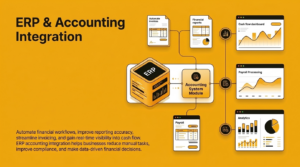
Integrated accounting systems improve financial accuracy and reporting efficiency.
Summary: Accounting integration improves financial accuracy, compliance, and decision-making.
Financial management is one of the most important functions within any organization. Integrating accounting software with ERP systems ensures that financial records remain accurate and up to date across all departments.
Transactions such as invoices, payments, purchase orders, and payroll updates can be automatically synchronized. This reduces manual bookkeeping tasks and provides finance teams with better visibility into cash flow and profitability.
Key points:
Organizations can generate more accurate reports and gain deeper insights into financial performance through integrated systems.
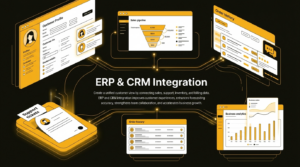
ERP and CRM integration creates a complete customer view for better sales performance.
Summary: CRM integration creates a complete view of customers and improves sales performance.
Customer expectations continue to rise, making it essential for businesses to deliver personalized experiences. Integrating CRM platforms with ERP systems helps organizations understand customers more effectively.
Sales representatives gain access to inventory levels, order histories, billing information, and support records from a single interface. This enables faster responses and more informed customer interactions.
Key points:
For companies implementing ERP integration , customer-centric operations become easier to manage and optimize.
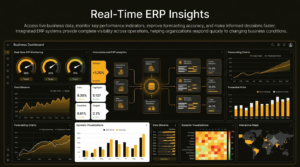
Real-time ERP analytics help businesses make faster and smarter decisions.
Summary: Integrated systems provide accurate data that supports faster and smarter business decisions.
Business leaders need timely information to respond to market changes, customer demands, and operational challenges. When accounting, CRM, and ERP systems are connected, executives can access real-time dashboards and reports.
Instead of waiting for manual updates from different departments, managers can review current performance metrics instantly. This leads to faster decision-making and improved strategic planning.
Key points:
Companies using modern erp software for small business often gain a competitive advantage through enhanced visibility and data-driven decision-making.
Summary: ERP integration reduces manual work and helps organizations operate more efficiently.
Operational efficiency directly impacts profitability. Every repetitive task eliminated through automation creates opportunities for employees to focus on higher-value activities.
Integrated systems reduce administrative overhead, minimize errors, and streamline workflows. As a result, organizations can achieve more with existing resources while maintaining service quality.
Key points:
Over time, the financial benefits of ERP integration often outweigh implementation costs.
As organizations grow, their operational complexity increases. Customer databases expand, transaction volumes rise, and reporting requirements become more demanding. Businesses that rely on disconnected systems often struggle to scale efficiently.
Integrated ERP environments provide a flexible foundation that supports expansion without requiring significant process changes. New departments, locations, and users can be added while maintaining consistent workflows and data management practices.
For growing companies, especially those adopting erp software for small business , integration helps ensure that technology remains aligned with long-term business objectives.
References:
Summary: While the benefits are significant, businesses may encounter challenges during implementation if planning is inadequate.
Successful ERP integration requires careful preparation. Many organizations underestimate the complexity of connecting accounting systems, CRM platforms, and operational processes. Data migration issues, employee resistance, and inconsistent workflows can delay implementation and reduce expected outcomes.
The good news is that most integration challenges can be addressed with proper planning, stakeholder involvement, and clear project goals. Businesses that invest time in understanding requirements before implementation often experience smoother transitions and faster returns on investment.
Key points:
Summary: A structured implementation approach minimizes risk and improves long-term success.
Businesses should begin by evaluating existing processes and identifying operational bottlenecks. Understanding how data currently moves between departments helps define integration requirements more accurately.
The next step involves selecting compatible solutions and establishing measurable objectives. Organizations should also create a phased implementation plan that allows testing before full deployment. Continuous monitoring after launch ensures systems continue delivering expected results.
Key points:
A systematic approach helps organizations maximize the value of erp software for small business while minimizing disruption.
Summary: Connected systems create faster, more personalized customer interactions.
Customer experience has become a major competitive differentiator. When CRM and ERP systems work together, customer-facing teams gain immediate access to relevant information such as order history, payment status, inventory availability, and service requests.
This unified view enables employees to resolve issues quickly and provide more personalized support. Customers no longer need to repeat information across multiple departments because data is already synchronized throughout the organization.
Key points:
Organizations that prioritize ERP integration often experience stronger customer relationships and higher retention rates.
Summary: Emerging technologies are making ERP ecosystems smarter, faster, and more connected.
The future of ERP integration is being shaped by cloud computing, artificial intelligence, automation, and advanced analytics. Modern ERP platforms increasingly support API-based integrations that simplify connections with accounting software, CRM applications, and third-party business tools.
Artificial intelligence is helping organizations automate repetitive processes, predict customer behavior, and identify operational inefficiencies. Meanwhile, cloud-based ERP solutions provide flexibility and scalability for businesses of all sizes.
Key points:
Businesses investing in modern erp software for small business can position themselves to benefit from these innovations.
Summary: Selecting the right ERP platform is essential for long-term business success.
Not all ERP systems offer the same integration capabilities. Businesses should evaluate software based on scalability, compatibility, customization options, security, and vendor support. The ideal solution should connect seamlessly with accounting and CRM applications while supporting future growth.
Organizations should also consider user experience, implementation costs, and industry-specific functionality. A well-chosen ERP platform can streamline operations for years, while a poor choice may create ongoing inefficiencies.
Key points:
Many growing organizations select erp software for small business that offers built-in accounting and CRM connectivity to simplify implementation.
Summary: ERP integration creates a connected business environment that improves efficiency, visibility, and customer satisfaction.
Integrating ERP systems with accounting and CRM platforms enables organizations to eliminate data silos, automate workflows, and make more informed decisions. By creating a unified source of truth, businesses can improve collaboration between departments while reducing operational inefficiencies.
As organizations continue embracing digital transformation, integrated systems will play an increasingly important role in supporting growth and competitiveness. Companies that invest in strategic integration initiatives today will be better prepared to adapt to future market demands.
Key points:
The value of ERP integration extends far beyond connecting software applications. It creates a foundation for smarter operations, stronger customer relationships, and more effective decision-making across the organization. As businesses face increasing pressure to improve efficiency and adapt quickly to changing market conditions, integrated ERP environments provide the visibility and control needed to succeed.
Whether a company is managing financial records, customer interactions, inventory, or sales operations, a well-integrated ERP system helps ensure that information flows seamlessly throughout the business. For organizations evaluating erp software for small business , prioritizing integration capabilities can deliver lasting benefits and support long-term growth objectives.
ERP integration is the process of connecting an ERP system with other business applications, such as accounting software and CRM platforms, so data can flow automatically between systems without manual entry.
ERP integration eliminates data silos, improves data accuracy, streamlines workflows, enhances collaboration between departments, and provides real-time visibility into business operations.
By connecting accounting software with an ERP system, businesses can automate financial data synchronization, reduce manual bookkeeping, improve reporting accuracy, and accelerate month-end and year-end closing processes.
ERP and CRM integration provides a complete view of customer information, improves sales forecasting, enhances customer service, streamlines order processing, and supports better customer relationship management.
Yes. ERP integration reduces repetitive manual tasks, minimizes errors, improves productivity, and streamlines workflows, helping organizations lower operational expenses over time.
Integrated systems provide real-time access to accurate business data, enabling managers and executives to make faster, data-driven decisions based on current performance metrics.

A profitable business does not merely depend on a good product but is significantly liable...

The ERP manufacturing companies are evolving and expanding at a rapid pace, thereby increasing competition...

In a short span of time, customer relationship management software has enormously advanced and picked...

Every year, we see the rise of new technologies., With each rising technology, we see...

The emerging economies are powering global growth. The world has witnessed the rise of manufacturing...

India is the world’s largest home to small and large-scale industries and a central hub...
The outbreaks of the Covid-19 virus caused worldwide panics and delivered a consequential blow to...
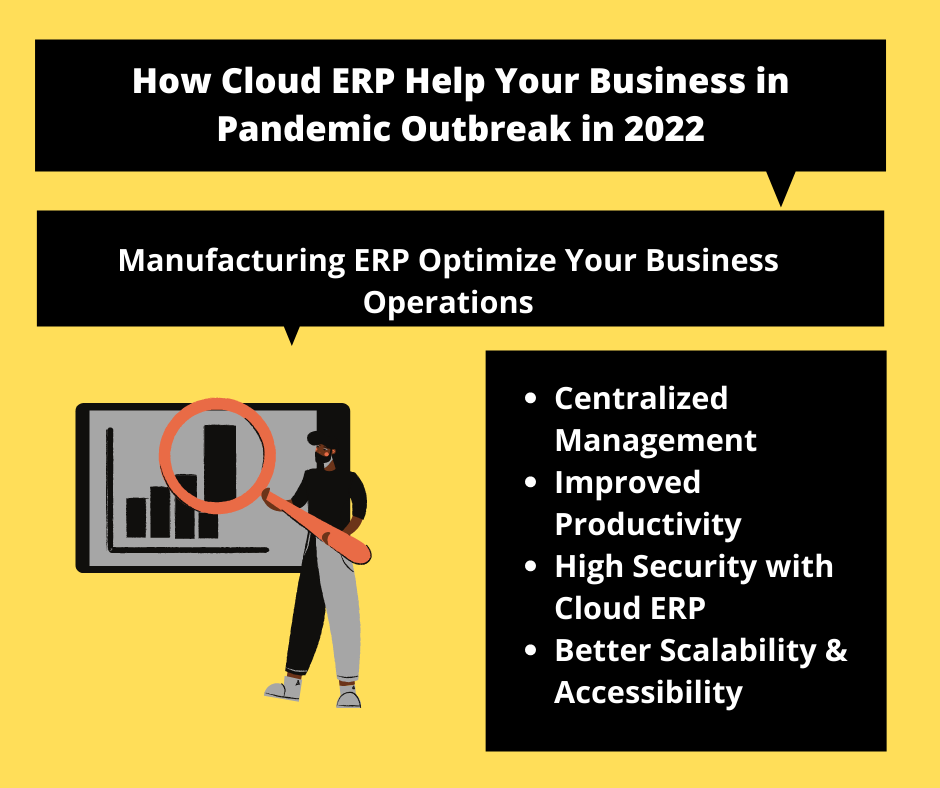
When the Cloud ERP Covid-19 pandemic came upon. It ushered in radical uncertainty and caused...

