
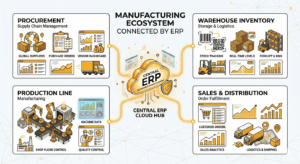
ERP integrates all manufacturing operations into one unified inventory management system.
Inventory management is one of the most critical and complex functions in manufacturing companies. From raw materials and work-in-progress (WIP) items to finished goods, maintaining accurate stock levels directly impacts production efficiency, cost control, and customer satisfaction. However, traditional inventory methods—often based on spreadsheets, manual tracking, or disconnected software—frequently lead to inefficiencies such as stock discrepancies, production delays, and excessive carrying costs.
This is where an ERP system for manufacturing becomes a game-changer. Enterprise Resource Planning (ERP) systems integrate all core business functions, including procurement, production planning, warehouse management, and sales, into a unified platform. By centralizing data and automating processes, ERP systems eliminate guesswork and provide real-time visibility into inventory movement across the entire manufacturing lifecycle.
In this first part of the article, we will explore the major inventory challenges faced by manufacturers, how ERP systems work in the context of inventory management, and the core mechanisms through which ERP solves long-standing inventory issues. This foundation will help you understand why ERP adoption has become essential for modern manufacturing businesses aiming for scalability, accuracy, and operational excellence.
Manufacturing environments deal with multiple inventory layers, including raw materials, components, sub-assemblies, and finished goods. Managing these manually or with outdated systems creates several operational bottlenecks. One of the biggest challenges is inventory inaccuracy, where recorded stock levels do not match physical inventory. This often leads to production delays or overstocking, both of which increase operational costs.
Another significant issue is the lack of real-time visibility. Without a centralized system, different departments—procurement, warehouse, and production—operate in silos. This disconnect results in poor coordination, delayed decision-making, and frequent miscommunication about material availability. Additionally, demand forecasting becomes unreliable, leading to either excess inventory or stockouts.
Manufacturers also struggle with inventory wastage and obsolescence, especially when raw materials have expiration dates or when demand patterns change rapidly. Poor tracking systems make it difficult to identify slow-moving or dead stock. Labor-intensive manual processes further increase the chances of human error in stock entry, transfer logs, and audit reports.
Key inventory challenges include:
These challenges collectively reduce productivity and profitability. Manufacturers often end up spending more time fixing inventory discrepancies than optimizing production. This creates a strong need for a centralized, automated solution that can unify inventory data and streamline operations—setting the stage for ERP systems to take over.
An Enterprise Resource Planning (ERP) system is a centralized software platform designed to manage and integrate all core business processes within an organization. In manufacturing, ERP plays a crucial role in connecting inventory management with production planning, supply chain operations, procurement, sales, and finance.
Unlike standalone inventory tools, ERP systems create a unified database where all inventory-related transactions are updated in real time. This means that when raw materials are received, consumed in production, or converted into finished goods, the system automatically updates stock levels across all departments. This eliminates data duplication and ensures accuracy throughout the organization.
ERP systems also integrate inventory management with demand forecasting and production scheduling. This allows manufacturers to plan material requirements more effectively and avoid disruptions in the production line. Additionally, ERP supports multi-location inventory tracking, making it easier for businesses with multiple warehouses or factories to maintain control over stock movement.
Core integration capabilities of ERP in inventory management include:
Beyond integration, ERP systems also provide advanced reporting and analytics features. These tools help managers identify trends, monitor stock performance, and make data-driven decisions. Instead of reacting to inventory problems after they occur, manufacturers can proactively manage stock levels and optimize supply chain efficiency.
By combining automation, integration, and analytics, ERP systems transform inventory management from a reactive process into a strategic business function that directly contributes to operational efficiency and profitability.
ERP systems address the root causes of inventory inefficiencies by introducing automation, accuracy, and real-time visibility into manufacturing operations. One of the most impactful improvements is real-time inventory tracking, which ensures that every movement of stock—whether inbound, outbound, or internal—is instantly recorded in the system. This eliminates discrepancies between physical and recorded inventory.
Another major benefit is the reduction of human error. Manual data entry is one of the leading causes of inventory inaccuracies. ERP systems automate these processes using barcode scanning, RFID integration, and system-generated updates, significantly improving data accuracy.
ERP also enhances decision-making through predictive analytics and demand forecasting. By analyzing historical sales data and production trends, the system helps manufacturers maintain optimal stock levels and avoid both overstocking and shortages.
Key ways ERP solves inventory problems:
In addition, ERP systems improve traceability, allowing manufacturers to track every component from supplier to finished product. This is especially important in industries with strict compliance requirements, such as pharmaceuticals, automotive, and food production. Traceability not only ensures quality control but also simplifies audits and regulatory reporting.
By aligning inventory data with production schedules and customer demand, ERP systems create a seamless workflow that minimizes downtime and maximizes resource utilization. This leads to faster production cycles, improved customer satisfaction, and better overall operational efficiency.
ERP integrates all manufacturing operations into one unified inventory management system.
Modern ERP systems come equipped with specialized features designed specifically for manufacturing inventory challenges. These features go beyond basic stock tracking and provide deep control over every stage of the supply chain, from procurement to final delivery. One of the most essential features is material requirement planning (MRP), which ensures that raw materials are available exactly when needed for production.
Another critical feature is warehouse management, which optimizes storage space, tracks stock movement, and improves picking and packing efficiency. ERP systems also offer batch and lot tracking, which is essential for quality control and product recalls.
Important ERP features for inventory management include:
Additionally, ERP systems provide dashboards and analytics tools that give managers a clear overview of inventory health. These dashboards display key metrics such as stock turnover rate, aging inventory, and reorder levels. This helps businesses identify inefficiencies and make informed decisions quickly.
Another powerful capability is workflow automation. For example, when stock levels fall below a predefined threshold, the ERP system can automatically trigger purchase requests or notify procurement teams. This reduces delays and ensures continuous production flow.
By combining these features, ERP systems provide manufacturers with complete visibility and control over their inventory operations. The result is a more efficient, cost-effective, and scalable manufacturing environment.
One of the most powerful evolutions in ERP systems is the integration of advanced analytics and artificial intelligence. Traditional inventory systems only report what is happening in real time, but modern ERP platforms go further by predicting what will happen next. This shift enables manufacturers to move from reactive inventory control to proactive optimization.
AI-powered ERP systems analyze historical sales data, seasonal demand patterns, supplier performance, and production cycles to generate highly accurate demand forecasts. This reduces uncertainty in procurement and ensures that raw materials are ordered in optimal quantities. It also minimizes carrying costs and prevents production disruptions caused by material shortages.
In addition, predictive analytics helps identify slow-moving inventory before it becomes obsolete. This allows manufacturers to take corrective actions such as discounts, redistribution, or production adjustments.
Key benefits of AI and analytics in ERP inventory systems include:
ERP systems also use machine learning algorithms to continuously improve forecasting accuracy. As more data flows through the system, predictions become more refined, helping manufacturers build a self-improving inventory ecosystem that reduces waste and improves efficiency over time.
Inventory management does not exist in isolation; it is deeply connected to the entire supply chain. ERP systems play a crucial role in synchronizing suppliers, manufacturers, warehouses, and distributors into a unified digital network. This synchronization ensures that inventory flows smoothly across all stages of production and delivery.
When integrated with supplier systems, ERP platforms enable real-time communication regarding purchase orders, shipment status, and delivery timelines. This reduces delays and improves material availability. It also allows manufacturers to adjust production schedules dynamically based on supplier performance or disruptions.
Modern ERP systems also support just-in-time (JIT) inventory strategies, where materials are ordered and received only when needed. This reduces excess stock and improves cash flow efficiency.
Key supply chain synchronization capabilities include:
By aligning inventory with supply chain operations, ERP systems significantly reduce bottlenecks and improve responsiveness. Manufacturers can adapt quickly to market demand changes, supplier delays, or unexpected production requirements without losing efficiency or accuracy.
Inventory is not just an operational asset—it is a major financial investment. Poor inventory management ties up working capital, increases storage costs, and leads to revenue loss through stockouts or wastage. ERP systems directly address these financial challenges by optimizing inventory levels and improving cost visibility.
With integrated financial modules, ERP systems provide real-time insights into inventory valuation, cost of goods sold (COGS), and carrying costs. This allows businesses to understand the true financial impact of their inventory decisions.
Additionally, automation reduces labor costs associated with manual tracking, auditing, and reporting. ERP systems also help minimize losses due to overproduction, expired materials, or inefficient procurement cycles.
Financial advantages of ERP in inventory management include:
By linking inventory data with financial reporting, ERP systems ensure that every material movement is reflected in real-time financial records. This eliminates discrepancies between operational and financial data, enabling more accurate decision-making and improved profitability.
As manufacturing companies grow, inventory complexity increases exponentially. More products, suppliers, warehouses, and markets create challenges that manual systems simply cannot handle. ERP systems are designed to scale alongside business growth, ensuring that inventory management remains efficient regardless of company size.
Cloud-based ERP platforms, such as Oracle NetSuite and Microsoft Dynamics 365, are particularly effective in supporting scalability. They allow manufacturers to expand operations without investing heavily in additional IT infrastructure.
Scalability is achieved through modular system design, multi-location support, and centralized data architecture. This ensures consistent inventory control even across global operations.
Key scalability advantages include:
ERP systems also support multi-currency and multi-language operations, making them ideal for international manufacturers. As businesses expand into new markets, ERP ensures that inventory operations remain standardized, transparent, and efficient across all regions.
While ERP systems offer powerful capabilities, successful implementation is critical to achieving maximum inventory efficiency. Poor implementation can lead to data migration issues, user resistance, and operational disruption. Therefore, manufacturers must follow structured best practices to ensure smooth deployment.
One of the most important steps is process mapping before implementation. This involves analyzing existing inventory workflows and aligning them with ERP functionalities. Proper training is also essential to ensure that employees can effectively use the system.
Best practices for ERP implementation include:
Another key factor is change management. Employees must understand how ERP improves their daily operations rather than viewing it as a complex replacement system. Continuous support and feedback loops help ensure long-term success.
Proper implementation ensures that ERP systems deliver maximum ROI by improving inventory accuracy, reducing costs, and enhancing overall operational efficiency.
The future of ERP systems in manufacturing is closely tied to emerging technologies such as IoT (Internet of Things), blockchain, and advanced automation. These technologies will further enhance inventory visibility, traceability, and efficiency.
IoT-enabled sensors can track inventory conditions in real time, such as temperature, humidity, and location. Blockchain can improve supply chain transparency by creating immutable records of material movement. Combined with ERP systems, these technologies will create fully automated, intelligent supply chains.
Future trends in ERP inventory management include:
These advancements will further reduce human intervention and make inventory systems more accurate, efficient, and resilient.
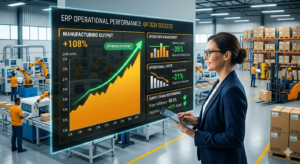
ERP empowers manufacturers to achieve scalable growth and digital transformation in inventory management.
ERP systems have fundamentally transformed inventory management in manufacturing by eliminating inefficiencies, improving accuracy, and enabling real-time decision-making. From basic stock tracking to advanced AI-driven forecasting, ERP platforms provide a complete solution for managing complex inventory ecosystems.
Solutions like SAP ERP, Oracle NetSuite, and Microsoft Dynamics 365 demonstrate how modern manufacturing businesses can achieve scalability, financial efficiency, and operational excellence through integrated inventory systems.
Ultimately, ERP is no longer just a software tool—it is a strategic backbone for manufacturing success. Companies that adopt ERP-driven inventory management gain a competitive advantage through reduced costs, improved agility, and enhanced production reliability in an increasingly complex industrial landscape.
ERP (Enterprise Resource Planning) is a centralized system that integrates inventory with procurement, production, sales, and finance. It provides real-time visibility of raw materials, WIP, and finished goods across the entire manufacturing process.
ERP eliminates manual tracking by automating stock updates through barcode scanning, RFID, and system-driven transactions. This reduces human errors and ensures that physical inventory matches system records.
ERP helps solve key issues such as stock inaccuracies, poor demand forecasting, lack of real-time visibility, overstocking, stockouts, and inefficient coordination between departments.
ERP systems update inventory instantly whenever materials are received, used, or transferred. All departments access the same centralized database, ensuring consistent and up-to-date information.
Yes. ERP reduces carrying costs by optimizing stock levels, minimizing wastage, improving procurement planning, and preventing overstocking or obsolete inventory buildup.
ERP uses historical data, sales trends, and production cycles to predict future demand. Advanced systems also use AI-driven analytics to improve forecasting accuracy over time.

A profitable business does not merely depend on a good product but is significantly liable...

The ERP manufacturing companies are evolving and expanding at a rapid pace, thereby increasing competition...

In a short span of time, customer relationship management software has enormously advanced and picked...

Every year, we see the rise of new technologies., With each rising technology, we see...

The emerging economies are powering global growth. The world has witnessed the rise of manufacturing...

India is the world’s largest home to small and large-scale industries and a central hub...
The outbreaks of the Covid-19 virus caused worldwide panics and delivered a consequential blow to...
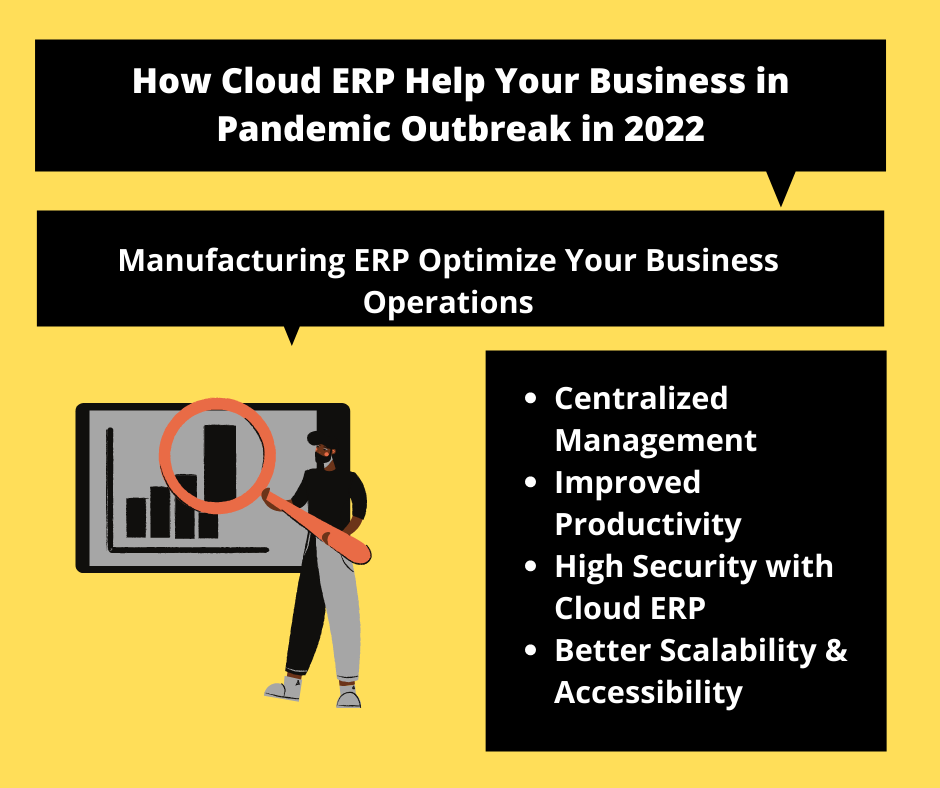
When the Cloud ERP Covid-19 pandemic came upon. It ushered in radical uncertainty and caused...

