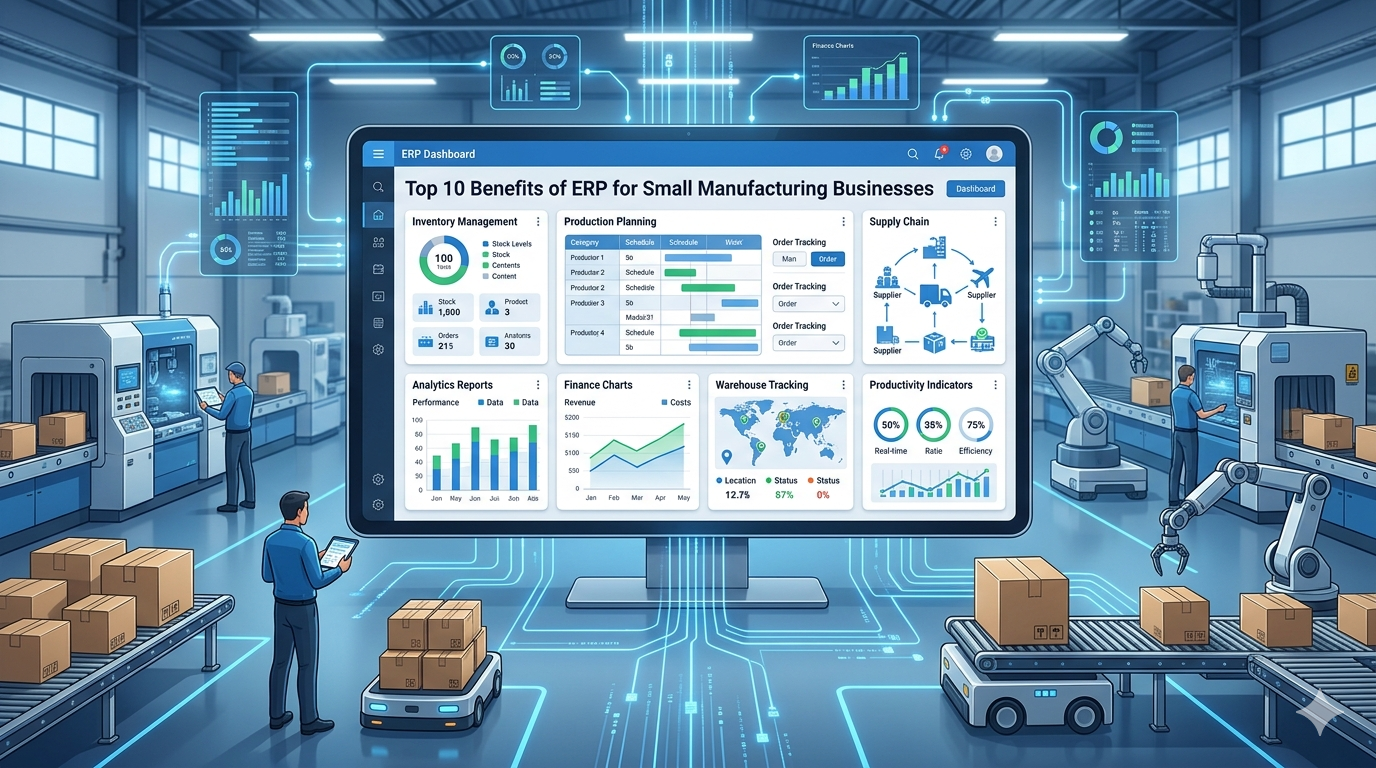
ERP systems help small manufacturers improve efficiency, inventory control, and long-term growth.
Small manufacturing businesses operate in a highly competitive environment where efficiency, cost management, and productivity directly impact long-term growth. Unlike large enterprises with extensive resources and dedicated teams, small manufacturers often work with limited budgets, smaller workforces, and tighter operational margins. Managing inventory, production schedules, supplier coordination, customer orders, and financial records manually can quickly become difficult as a business grows.
Many small manufacturing companies initially rely on spreadsheets, standalone software applications, or manual tracking methods to manage day-to-day activities. While these systems may work in the early stages of business operations, they often create challenges over time. Data duplication, communication gaps, delayed reporting, inventory inaccuracies, and inefficient workflows can negatively affect productivity and profitability.
Enterprise Resource Planning (ERP) systems provide a practical solution to these challenges by integrating multiple business functions into one centralized platform. ERP software combines inventory management, production planning, finance, procurement, customer management, and reporting into a unified system that enables businesses to work more efficiently.
For small manufacturers, ERP implementation is not simply a technology upgrade. It is a strategic investment that improves operations, enhances decision-making, and supports sustainable growth. Below are the top ten benefits of ERP for small manufacturing businesses and how these systems contribute to operational success.
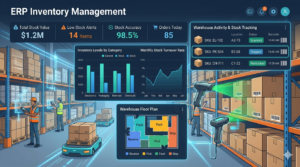
ERP systems provide real-time inventory visibility and improve stock control.
Inventory management is one of the most important operational functions in manufacturing businesses. Managing raw materials, work-in-progress products, and finished goods manually can become complicated and lead to errors.
Without proper inventory control, businesses often experience problems such as:
ERP systems provide real-time visibility into inventory levels and movements. Businesses can track stock availability, monitor incoming materials, and automatically update inventory information after each transaction.
Key inventory benefits include:
Efficient inventory management helps businesses reduce waste and maintain smoother manufacturing operations.
Small manufacturers frequently spend significant time performing repetitive tasks manually. Activities such as entering data, generating reports, processing purchase orders, and updating inventory records consume valuable resources.
ERP software automates many of these tasks and creates more streamlined workflows across departments.
Benefits of improved operational efficiency include:
Automation enables staff to focus on more valuable tasks instead of spending excessive time on routine administrative work.
Improved operational efficiency also allows businesses to complete more work with fewer resources, creating a stronger competitive advantage.
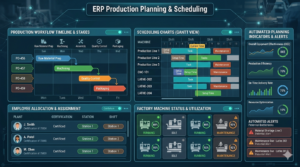
ERP software helps manufacturers improve production scheduling and resource allocation.
Production planning plays a major role in manufacturing success. Poor scheduling often results in delayed orders, idle machinery, labor inefficiencies, and customer dissatisfaction.
ERP systems help businesses create more accurate production plans by analyzing available resources and demand forecasts.
ERP production planning benefits include:
Manufacturers can use ERP systems to monitor production stages and adjust schedules whenever unexpected situations occur.
Better planning ensures smoother operations and helps businesses meet customer expectations more consistently.
Many small businesses operate with information stored across multiple spreadsheets and systems. This often leads to duplicate records, inconsistent information, and human errors.
ERP systems centralize business information into a single database, reducing data inaccuracies.
Benefits include:
When everyone accesses the same information, communication becomes more efficient and decision-making becomes more reliable.
Data accuracy is particularly important because even small errors in manufacturing environments can create significant operational problems.
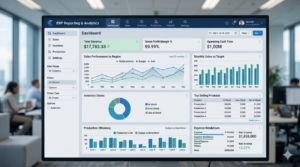
ERP analytics help businesses make faster and more informed decisions.
Business decisions become more effective when leaders have access to current and accurate information. ERP systems provide real-time reporting and analytical tools that help businesses monitor performance continuously.
Common ERP reports include:
Benefits of real-time analytics:
Instead of waiting for manually generated reports, managers can instantly access business data whenever needed.
This visibility helps identify issues early and supports proactive decision-making.
Customer satisfaction has a direct influence on business growth and retention. Delays in order processing, inaccurate delivery estimates, and poor communication can negatively impact customer relationships.
ERP systems improve customer service by providing better access to customer and order information.
Customer-related advantages include:
Employees can quickly retrieve customer information and provide updates regarding order status.
Providing a better customer experience increases trust and strengthens long-term relationships.
Cost management is a priority for small manufacturing businesses because profit margins are often limited.
ERP systems help reduce operating expenses in several ways:
Cost reduction benefits include:
Although ERP implementation requires initial investment, businesses frequently achieve long-term savings through improved efficiency and process optimization.
Over time, reduced operational costs can significantly strengthen overall business performance.
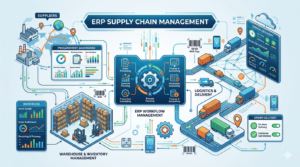
ERP systems improve supplier coordination and supply chain efficiency.
Manufacturing businesses rely heavily on suppliers, procurement activities, and logistics processes.
Without proper coordination, businesses may experience:
ERP systems improve supply chain visibility and coordination.
Supply chain advantages include:
ERP systems also help businesses evaluate supplier performance and identify opportunities for improvement.
A stronger supply chain contributes to smoother manufacturing processes and improved customer satisfaction.
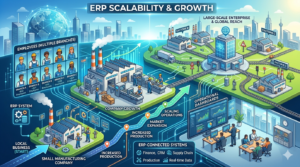
ERP systems scale alongside growing manufacturing businesses.
As small manufacturing businesses expand, operational complexity increases significantly.
Growth often introduces challenges such as:
ERP systems are designed to scale alongside business growth.
Growth-related benefits include:
Instead of replacing systems as the business grows, ERP platforms can adapt to changing needs.
This scalability reduces future disruption and creates a more stable growth foundation.
Business success often depends on making informed decisions quickly.
ERP systems support decision-making by providing:
Decision-making benefits include:
Managers can analyze performance trends and identify opportunities or challenges before they become larger problems.
Better decisions often lead to stronger competitiveness and improved business outcomes.
ERP systems have become increasingly valuable for small manufacturing businesses because they simplify complex operations and create more efficient workflows. From inventory management and production scheduling to customer service and supply chain coordination, ERP technology provides a centralized solution that improves overall business performance.
The top benefits of ERP include improved inventory control, increased efficiency, stronger data accuracy, cost reduction, scalability, and better decision-making. These advantages help small manufacturers operate more effectively while preparing for long-term growth.
As manufacturing environments continue becoming more competitive, businesses that adopt ERP systems early are often better positioned to improve productivity, increase profitability, and maintain sustainable success in the future.
1. What is ERP in manufacturing?
ERP in manufacturing is a centralized software system that helps businesses manage inventory, production, finance, supply chain operations, and reporting from a single platform.
2. Why do small manufacturing businesses need ERP?
Small manufacturers use ERP to improve efficiency, reduce operational costs, manage inventory accurately, and support business growth.
3. Can ERP reduce manufacturing costs?
Yes. ERP can reduce costs through inventory optimization, workflow automation, improved resource allocation, and lower administrative expenses.
4. Is ERP suitable for small businesses?
Yes. Modern ERP systems are scalable and designed for businesses of different sizes, including small manufacturers.
5. How does ERP improve inventory management?
ERP provides real-time inventory tracking, stock monitoring, automated updates, and better demand forecasting.

A profitable business does not merely depend on a good product but is significantly liable...

The ERP manufacturing companies are evolving and expanding at a rapid pace, thereby increasing competition...

In a short span of time, customer relationship management software has enormously advanced and picked...

Every year, we see the rise of new technologies., With each rising technology, we see...

The emerging economies are powering global growth. The world has witnessed the rise of manufacturing...

India is the world’s largest home to small and large-scale industries and a central hub...
The outbreaks of the Covid-19 virus caused worldwide panics and delivered a consequential blow to...
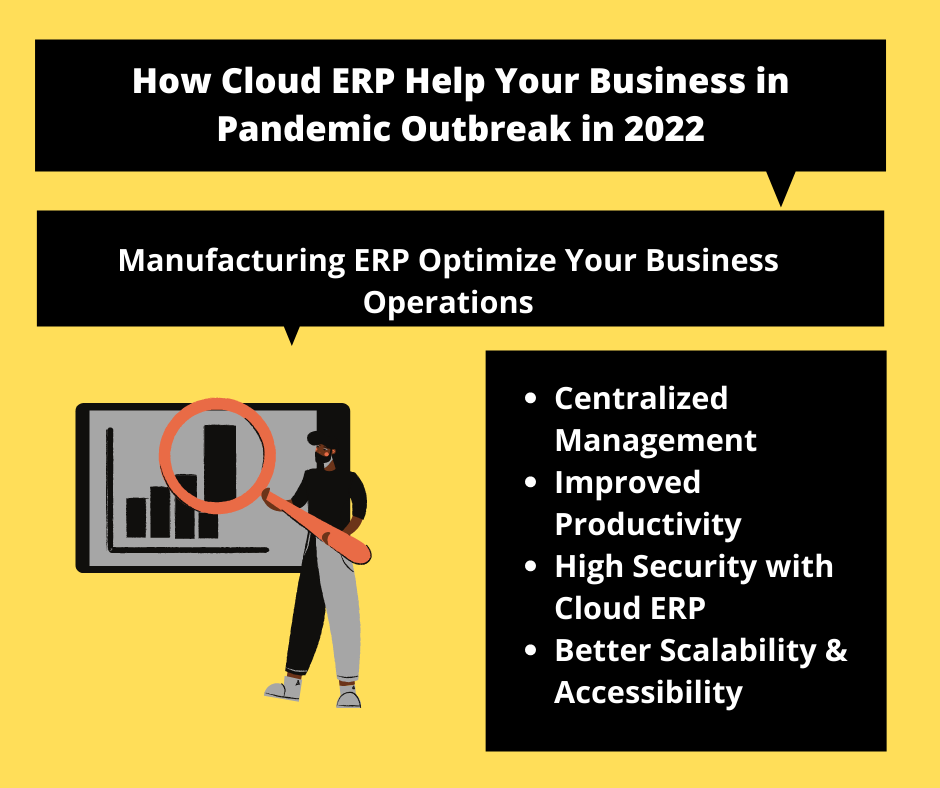
When the Cloud ERP Covid-19 pandemic came upon. It ushered in radical uncertainty and caused...

